
The Rollover Strategy Most Advisors Miss: Turning Qualified Money into Tax-Free Long-Term Care
Created by: David Beas, Life Marketing Consultant, Cavalier Associates
Featuring: Jen Wagoner, Regional Account Director, Care Solutions Sales Distribution, OneAmerica
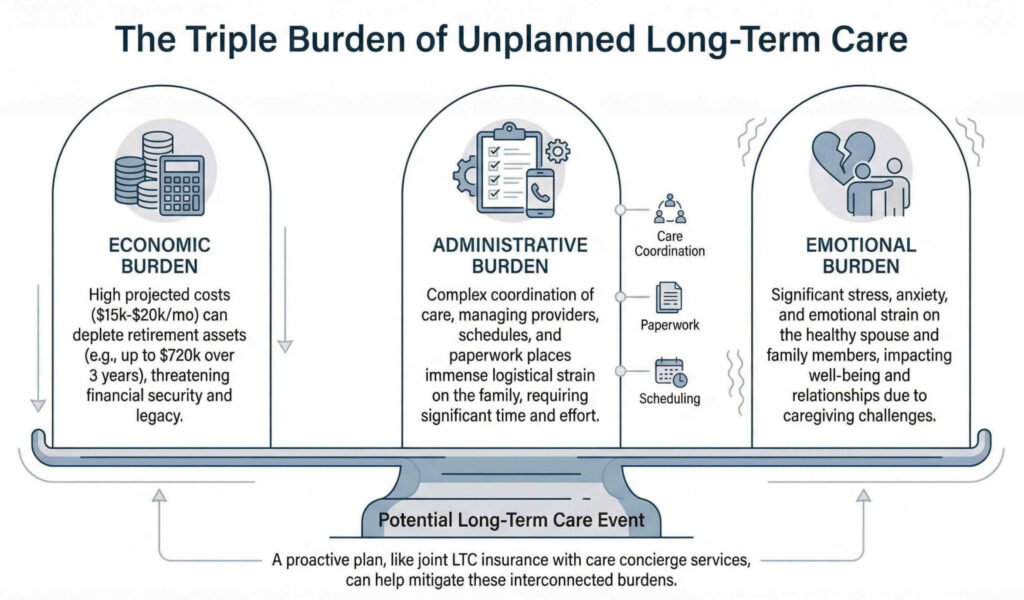
Most people picture long-term care starting in a nursing home. In reality, it usually starts much smaller and much closer to home — a shaking hand at the dinner table, a pair of shoes no longer where they’ve sat for thirty years. By the time a family recognizes what’s happening, they’re already living with what we call the three burdens of long-term care: the emotional burden, the economic burden, and the administrative burden.
The emotional burden is the one no policy can insure against — families have to face it directly. The economic burden is what usually starts the conversation about long-term care insurance in the first place. But the administrative burden is the one most people never see coming: coordinating care, vetting providers, making sure a vulnerable loved one is actually being looked after and not taken advantage of. Partnering with the right insurance carrier can lift a meaningful share of both the economic and administrative load — freeing families to focus on the part that matters most, the emotional one.
That’s the foundation for a strategy we’ve spent the last two years bringing to advisors: using qualified retirement money to fund long-term care coverage for a client and their spouse, without asking clients to write a new check.
Turning an IRA Into Tax-Free LTC Coverage
One America is the only carrier offering a turnkey way to fund a long-term care policy using qualified (pre-tax) assets — for one spouse or both. The strategy is called Asset Care Annuity Funding Whole Life, and the mechanics are more approachable than the name suggests.
Here’s how it plays out for a hypothetical 60-year-old married couple. The husband repositions $160,000 of IRA money into a One America IRA annuity. Because an income rider turns on immediately, that transfer receives a 25% premium bonus — $40,000 — bringing the total to $200,000. Over the next ten years, that account systematically distributes $20,000 annually to fund a ten-pay Asset Care whole life policy.
That premium pays up two things at once: the life insurance death benefit and the annual premium for a continuation-of-benefits rider. Structured with an unlimited lifetime benefit, the policy provides:
- A death benefit of $177,600 if neither spouse ever needs long-term care
- A lifetime monthly benefit of $7,400 per person if they do — nearly $15,000 combined per month if both are on claim simultaneously
One America is currently the only carrier still offering an unlimited lifetime benefit design like this.
What happens if a claim starts early?
Say the husband goes on claim at year five, five years into the ten-year funding period. Every asset-based long-term care policy from One America includes a true waiver of premium — not a deferral, an actual waiver. The $20,000 due that year isn’t clawed back later or deducted from the death benefit pool. Meanwhile, the IRA annuity’s distribution keeps coming out on schedule and is simply issued back to the client. If he later recovers, the policy is already paid up and both spouses retain lifetime coverage going forward.
Lifetime Benefit vs. a Defined Benefit Period
Advisors typically present two versions of this design side by side. About 20-30% of clients gravitate toward the unlimited lifetime option, often because they’ve personally seen a long-term care event stretch on for years. The rest tend to land on a defined benefit period — commonly six years — which statistically covers the vast majority of real-world claims.
Using the same $160,000 → $200,000 funding and the same ten-year distribution, a six-year (72-month) benefit design shifts the premium allocation to boost the monthly benefit instead of extending the benefit period indefinitely. In this version, the monthly benefit per person increases to $10,945, drawn from a shared pool of $849,585. Inflation protection can be layered onto either design — either growing for 20 years and then leveling off, or continuing to grow for the life of the policy, even while a claim is active.
Why the Distribution Is Taxable — and Why That’s the Point
The annual $20,000 distribution from the IRA annuity is a taxable event, reported on a 1099 and taxed as ordinary income. That’s precisely why this strategy is positioned for clients age 59½ and older. It’s best understood as a “super Roth conversion”: rather than paying tax now to receive tax-free retirement income later, clients pay tax now to receive tax-free long-term care benefits later — while simultaneously reducing the qualified balance that will eventually drive required minimum distributions.
Who This Strategy Fits
This isn’t a strategy built on arbitrary numbers. The target profile: married couples age 60 or older, homeowners, with $1 million to $5 million in net worth (the lower bound can flex down for clients with a pension). The $160,000 funding figure specifically was chosen because it consistently triggers over $500,000 in benefit for clients under 67 — roughly 4-to-1 leverage — and, in practice, tends to generate more client buy-in than showing a larger number upfront.
The Case for Repositioning vs. Self-Insuring
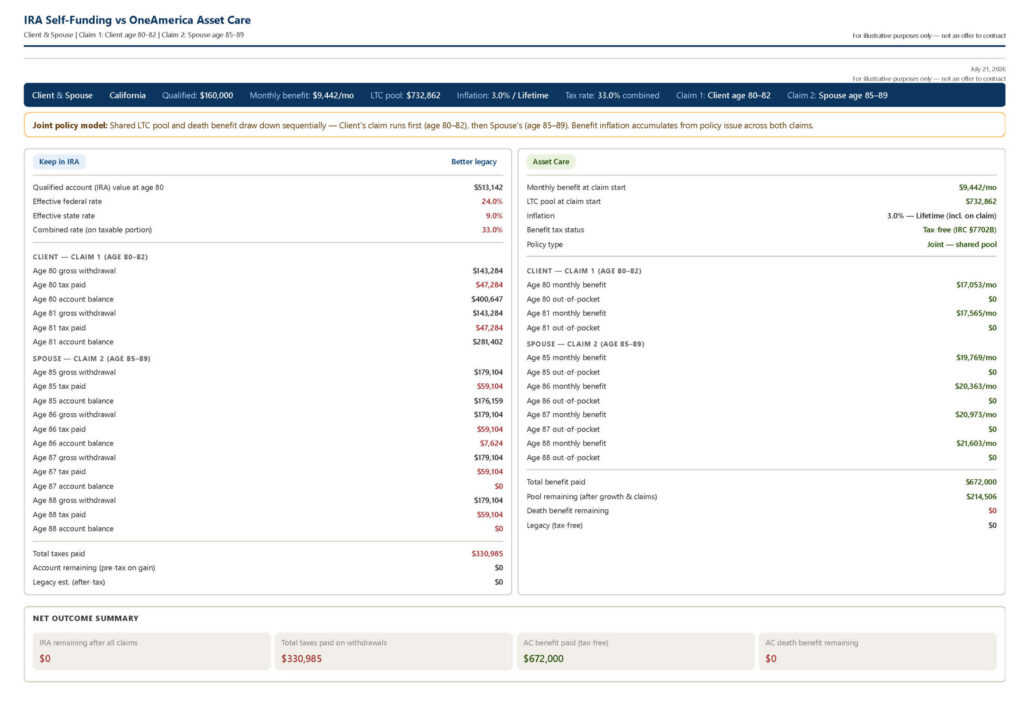
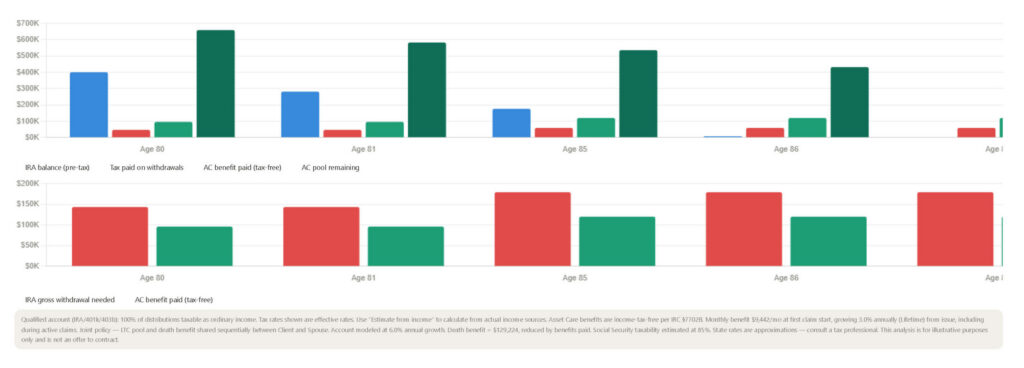
A common advisor objection: “What if my client just keeps that money invested instead?” Modeled at a conservative 6% return and a 23% combined tax rate, a couple self-funding long-term care from an IRA — $8,000/month for the husband’s claim, followed by a longer claim period for the wife — sees their $481,000 balance at age 80 fully exhausted by roughly age 87.
Compare that to the One America program: the same funding produces $672,000 in tax-free benefits paid out, with $177,000 still remaining. Repositioning a portion of qualified assets doesn’t mean giving up growth potential on the rest — it means the portion earmarked for long-term care is guaranteed to be enough, so the remainder can be invested more aggressively without that risk hanging over it.
A Second Path: Annuity Care for Existing Non-Qualified Annuities
For clients who already hold a non-qualified annuity with unrealized gains, there’s a second strategy worth knowing. Under the Pension Protection Act, a non-qualified annuity can be 1035-exchanged into a PPA-compliant annuity, allowing the gains to be withdrawn completely tax-free when used for long-term care expenses — instead of being taxed last-in-first-out on a standard withdrawal.
One America built its Annuity Care product around this provision, and the underwriting is refreshingly simple: applicants answer four knockout questions, and a “no” to all four means instant approval — no underwriter review required. The maximum issue age is 87, which makes this a strong fit for older clients whose existing annuities are sitting untouched and earmarked, informally, for “someday.”
In one example, a 77-year-old female client transfers $200,000 into an Annuity Care policy. By age 87, that pool has grown to $306,000, generating $8,874 per month in completely tax-free long-term care benefits.
Beyond the Check: The Care Benefit Concierge
Leverage and tax treatment matter, but they don’t address the administrative burden we started with. That’s where One America’s Care Benefit Concierge comes in — a dedicated three-person claims team assigned to a case from the start of a claim through its resolution. The team supports the entire family, not just the policyholder, helping with bill administration, paperwork, and connecting families to additional resources throughout what is often a multi-year journey.
The Bottom Line
Ninety-seven percent of the assets in this country sit in retirement accounts that haven’t been taxed yet. For the right client — a couple in their 60s with home equity and meaningful qualified assets — repositioning a portion of that money into a long-term care strategy can convert an eventual tax liability into guaranteed, leveraged, tax-free care funding, without asking them to find new dollars.
If you have a client or a segment of your book that fits this profile, we’re happy to run the numbers and put together a side-by-side illustration.
For additional insights or to schedule a planning conversation, contact:
David Beas – Life Marketing Consultant, Cavalier Associates
800.350.2019 / dbeas@cavalierassociates.com
Scheduling Link: https://app.usemotion.com/meet/david-beas/Zoom?d=30
Other Interesting Articles
The contents of this document should not be considered as tax or legal advice. Any information or guidance provided is solely for educational or informational purposes and should not be relied upon as a substitute for professional advice. It is always recommended to consult with a licensed financial or legal advisor for specific guidance related to your individual situation.
